An AI teammate that now works inside your own editor, a visual builder rebuilt into a real design tool, and an SDK that finished its migration and now carries almost every player on the platform.
The first half of 2026 was our most productive stretch yet. We pushed on three fronts at once — intelligence, creation, and foundation — and they’ve converged into a platform that feels genuinely different to use. 🚀
Here’s the half-year in one place.
- 30M+ monthly players across games running on Balancy.
- 12B+ requests served every month.
- 6 platforms from a single core — iOS, Android, Windows, macOS, WebGL, and Web.
- 9 in 10 players now running on our new C++ SDK.
Nia went from assistant to operator — and moved into your editor
Earlier this year we introduced Nia, Balancy’s built-in AI. In the first half of 2026 we gave her hands.
Nia no longer just answers questions about your project — she builds in it. Ask in plain language — “spin up a weekend flash sale,” “animate this offer’s reward burst,” “add a new tier to the battle pass” — and she creates and edits the real thing directly inside Balancy: views, visual scripts, animation clips, particle effects, templates, offers, store items, prices, localizations, A/B tests and overrides. No build cycle, no engineering ticket.
She also works the other way round. Ask what’s live right now, why a segment isn’t filling, or what your current configuration actually does, and she reads the project and tells you.
The bigger shift landed in July: you can now connect your own AI to Balancy over MCP. Claude Code, Codex, Cursor, Claude Desktop — plug any of them straight into your live game data and keep working where you already work.
It stops being a code assistant and becomes a permanent teammate on the project — one that knows what’s configured, spots what looks off, recommends what to change, and then goes and makes the change. And because it speaks UI Builder too, it can lay out the screen for you instead of handing you a to-do.
Every change is routed through your own Balancy session running in your browser, so you review it before anything is saved. If that session isn’t open, nothing can be changed.
The full walkthrough — connecting your assistant and putting it to work on a real project — is in Connect Your Own AI (MCP).
UI Builder, rebuilt into a real design tool
If Nia is the operator, UI Builder is the studio — and this half we rebuilt it. Not a coat of paint: a full animation system, a component system, a code mode, and a reworked editing model. Teams now design rich, animated, data-bound LiveOps screens without touching the game build.
A complete animation system, inside the browser. A proper timeline and dopesheet — keyframes, easing curves, per-property tracks, copy-paste, multi-clip management and live scrubbing right on the canvas. Native Lottie playback and a particle-effects system bring screens to life, and the redesigned canvas adds zoom, pan and auto-fit for precise work.
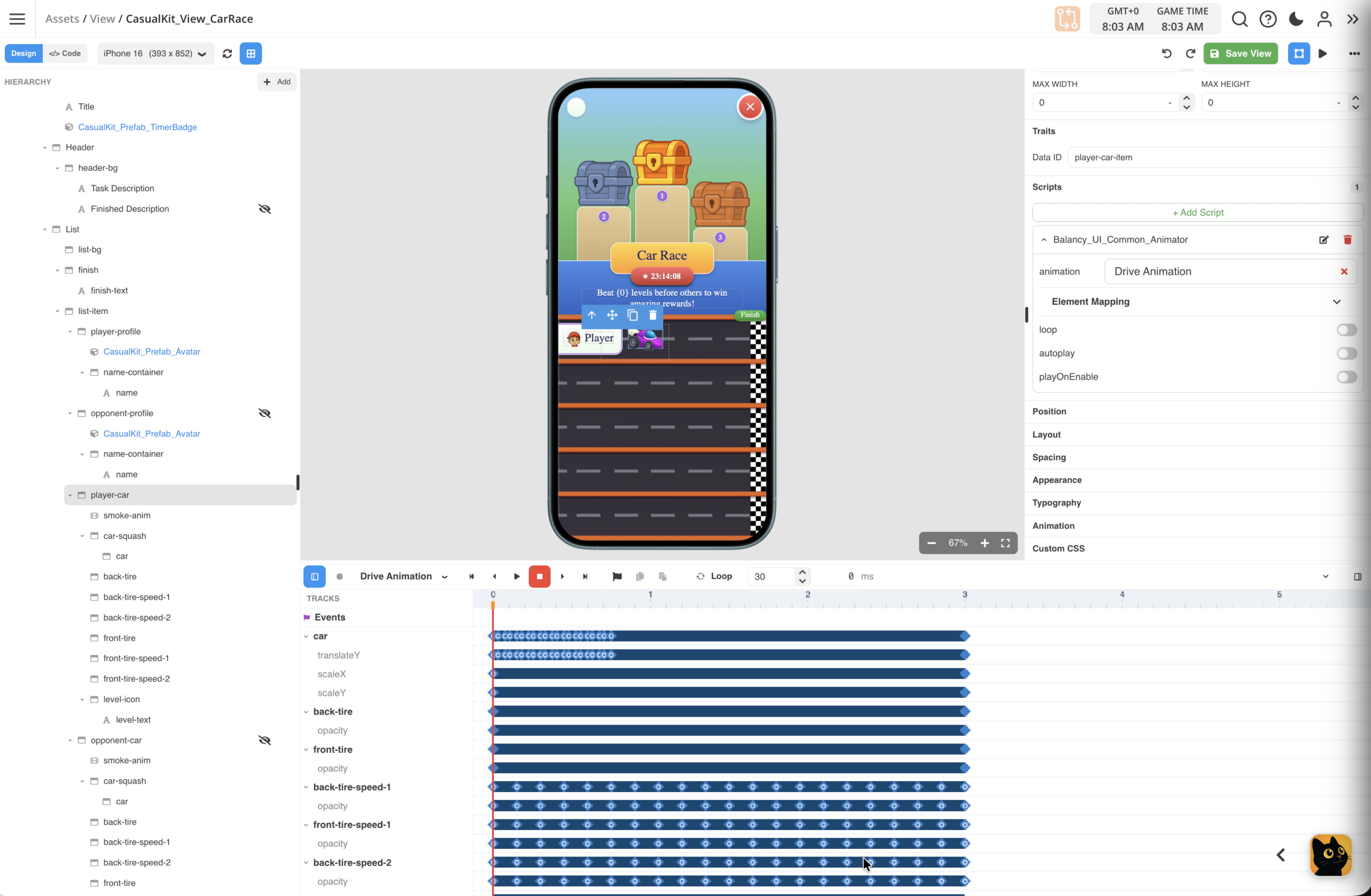
Prefabs: Unity-style components for web UI. Build a Buy Button, an item-with-amount row or a whole offer layout once, then reuse it everywhere — edit the source and every instance follows. We shipped a public Balancy UI Prefabs package to demonstrate it, with ready-made buy buttons, simple and group offer views, and a full game shop, all wired up with built-in scripts.
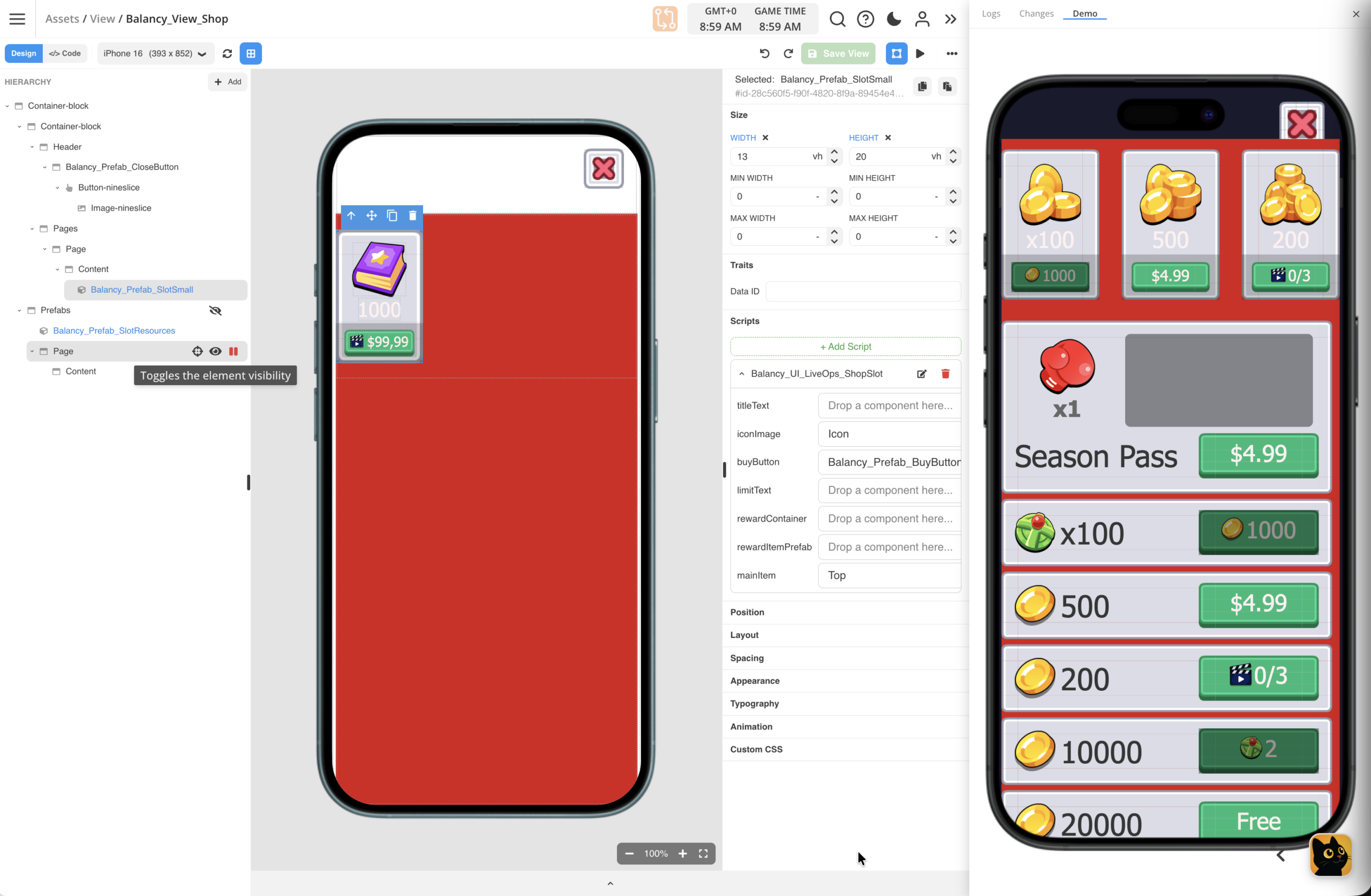
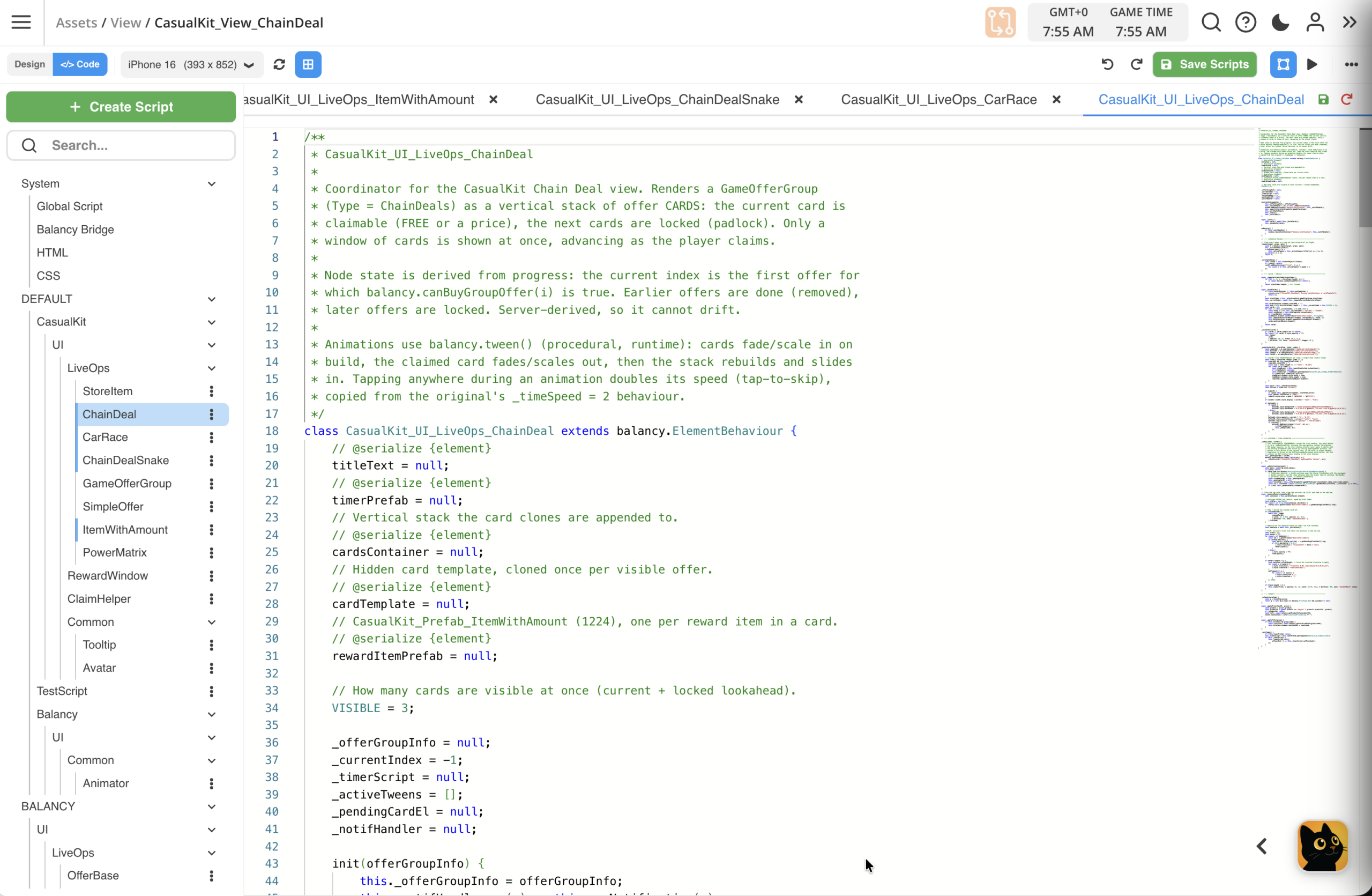
Faster to work in. A full-screen Code Mode sits next to Design Mode for editing HTML, CSS, scripts and bridge code inline. The Style and Traits panels merged into one scrollable inspector. Device previews now cover tablet and desktop as well as phones.
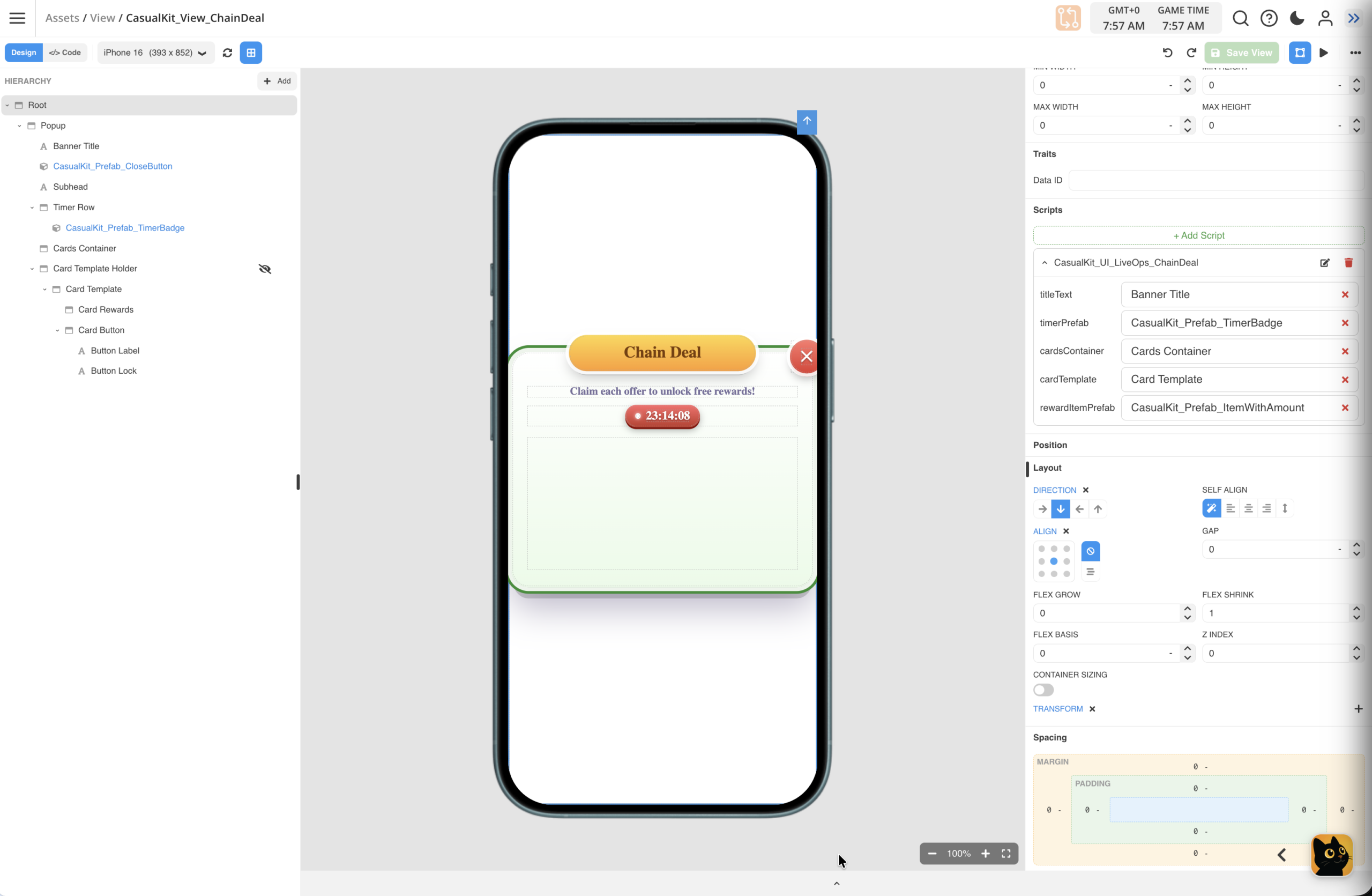
One highlight designers keep coming back to: Import HTML — drop in existing markup and Balancy converts it into an editable, data-bound view in seconds.
The SDK finished its migration — and now carries almost everyone
Balancy used to run on an engine-specific SDK. Today it runs on a single C++ core — compiled natively for every platform we support, and to WebAssembly for the web. 2026 is the year that migration finished: everything the old SDK could do, the new one now does, plus a great deal it never could. More than nine in ten players on the platform are running on it.
One core, every platform. The same engine, the same behavior and the same API everywhere. In Unity that means iOS, Android, Windows, macOS and WebGL — including standalone desktop builds shipping on Steam. On the web it’s a native TypeScript/JavaScript SDK built on the identical core, with Cocos Creator supported alongside it. One configuration, one set of LiveOps, every build target.
Underneath a small API, the SDK carries a lot on the game’s behalf: it delivers and caches configuration, keeps the player’s profile synced with the cloud, evaluates conditions and segments continuously, schedules events and offers, runs visual scripts, drives the store and payments, renders LiveOps screens, and streams analytics — behaving identically on every platform. We shipped fourteen SDK releases between January and June, and the cadence hasn’t slowed since.
Built for long sessions and real networks. Configuration and assets are delivered over CDN and cached on the device, so a returning player starts instantly and a weak connection is handled for them. Profiles sync to the cloud and follow the player across reinstalls and devices. New content lands mid-session without interrupting play. Memory stays inside a fixed budget however long a session runs, and the SDK is safe to read from any thread — so an hour-long session on a mid-range Android phone behaves exactly like a fresh one.
New in the same stretch:
- Cloud storage for custom collections — store and sync your own data collections alongside the player’s profile.
- Dynamic rewards — attach a visual script to a store item and compute its reward from live game state.
- Custom conditions — target players on logic you define yourself.
- List and array editing in visual scripting — read and modify collections directly inside your scripts.
- Live shop updates — stores reshape mid-session when an A/B test or segment changes, with no restart.
- Event-state targeting — reach players based on whether a previous event is active, finished, or never happened.
- Expanded payments and store logic.
If you’re still on the old SDK, this is the half where moving became the obvious call — and we’ll help you do it.
Proof it works: shipping at scale
The best validation is a partner betting on the platform. One of the world’s largest mobile music-game publishers has now shipped more than a dozen distinct LiveOps activities built entirely on our new technology stack — and their usage keeps growing.
Across every game running on Balancy, the platform now serves more than 30 million players a month and over 12 billion requests in that same window, on infrastructure that absorbs weekend peaks without anyone touching it.
That’s the loop we want: real games, real players, driving the roadmap.
The second half is about going further
We’re deepening Nia, expanding our templates and market-intelligence layer, and helping more studios ship LiveOps faster than they thought possible.
If that sounds like your team — let’s talk.