From assistant to autonomous platform – this is what the future of LiveOps looks like.
For years, LiveOps optimization meant manual analysis, constant back-and-forth between departments, and long engineering cycles. Balancy was built to change that – our platform already lets product teams run LiveOps without shipping a new build.
Today, we’re going further…🚀🪐
What we launched: Nia, your AI LiveOps assistant
We’re announcing Nia – Balancy’s AI assistant, embedded directly in the platform.
Nia understands your game data, your offer structures, segmentation logic, and event setup. Here are some things you can ask her:
→ Set up a Flash Sale event with a 20% discount on gem packs.
→ Check my game store products for economic imbalance in prices and rewards.
→ How to create a remote config in Balancy to control game characters’ abilities?
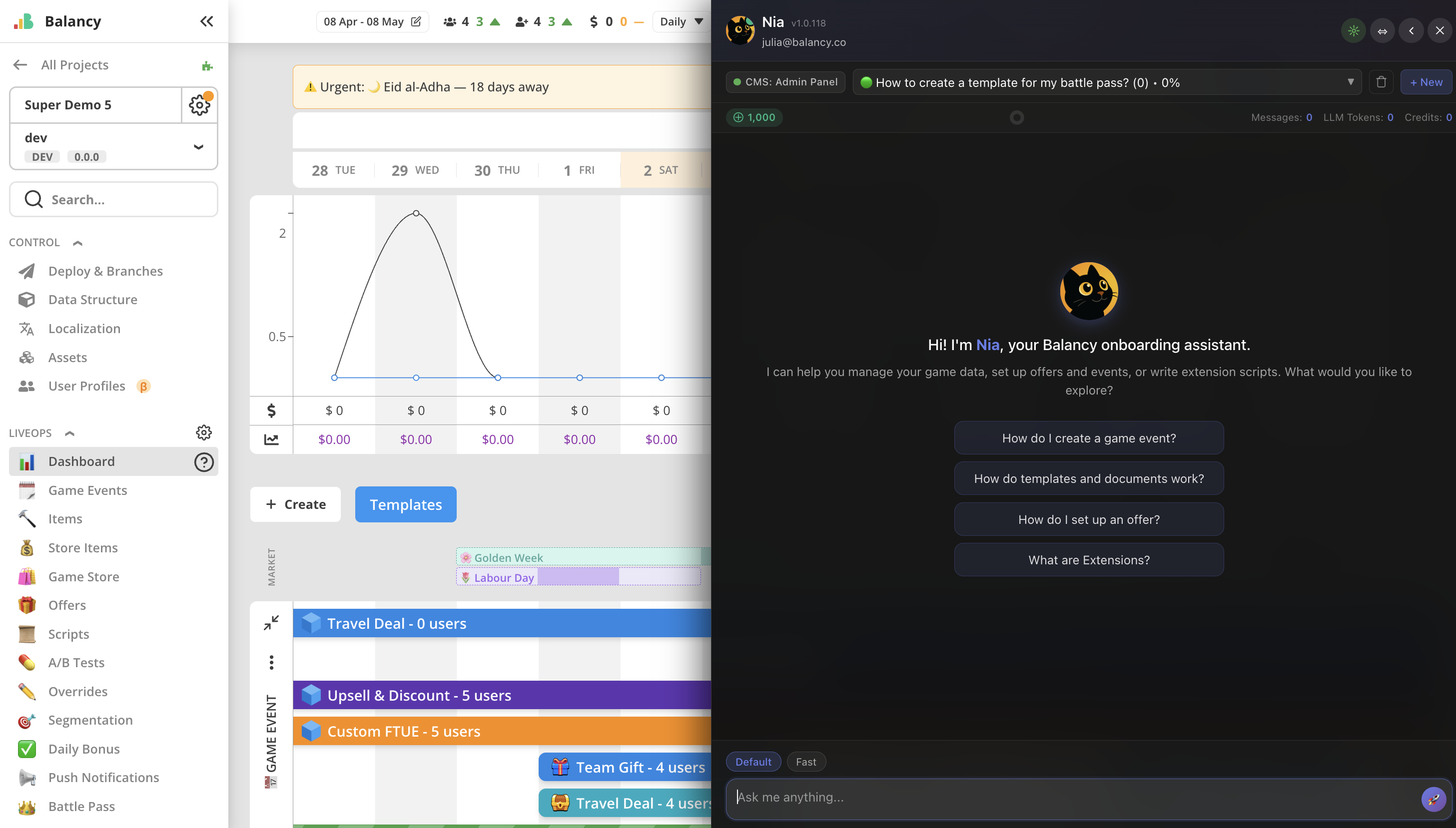
This is not a generic chatbot bolted onto a dashboard. Nia has read and write access to your LiveOps configuration and can execute changes directly. She can create or modify game events, offers, data templates, experiments, and localization strings.
For teams managing hundreds of concurrent LiveOps activities, the time savings are immediate. But an assistant that answers questions and executes instructions is just the foundation.
The real shift is what comes next, and Balancy is already working on it.
The problem with reactive LiveOps
Most teams only catch problems after the fact. An analyst notices a poorly converting offer, flags it, and queues a fix for the next sprint. That offer keeps running for another two weeks, losing revenue the whole time.
And even when teams do catch something quickly, acting on it has always been slow. A tweaked price, a new pop-up design, an added timer – all of it had to go through an engineering release cycle.
Balancy already solves the second part. Every offer, event, and A/B test on our platform goes live with no app update required. Now we’re solving the first part too – catching problems faster, and fixing them instantly.
The vision: AI that helps you to grow LTV
Watch this video to see our CEO, Pavel Ignatov, talk about the full scope of the AI engine for LiveOps that the team is building.
Here is the full scope of what we are working on:
Step 1. Detection
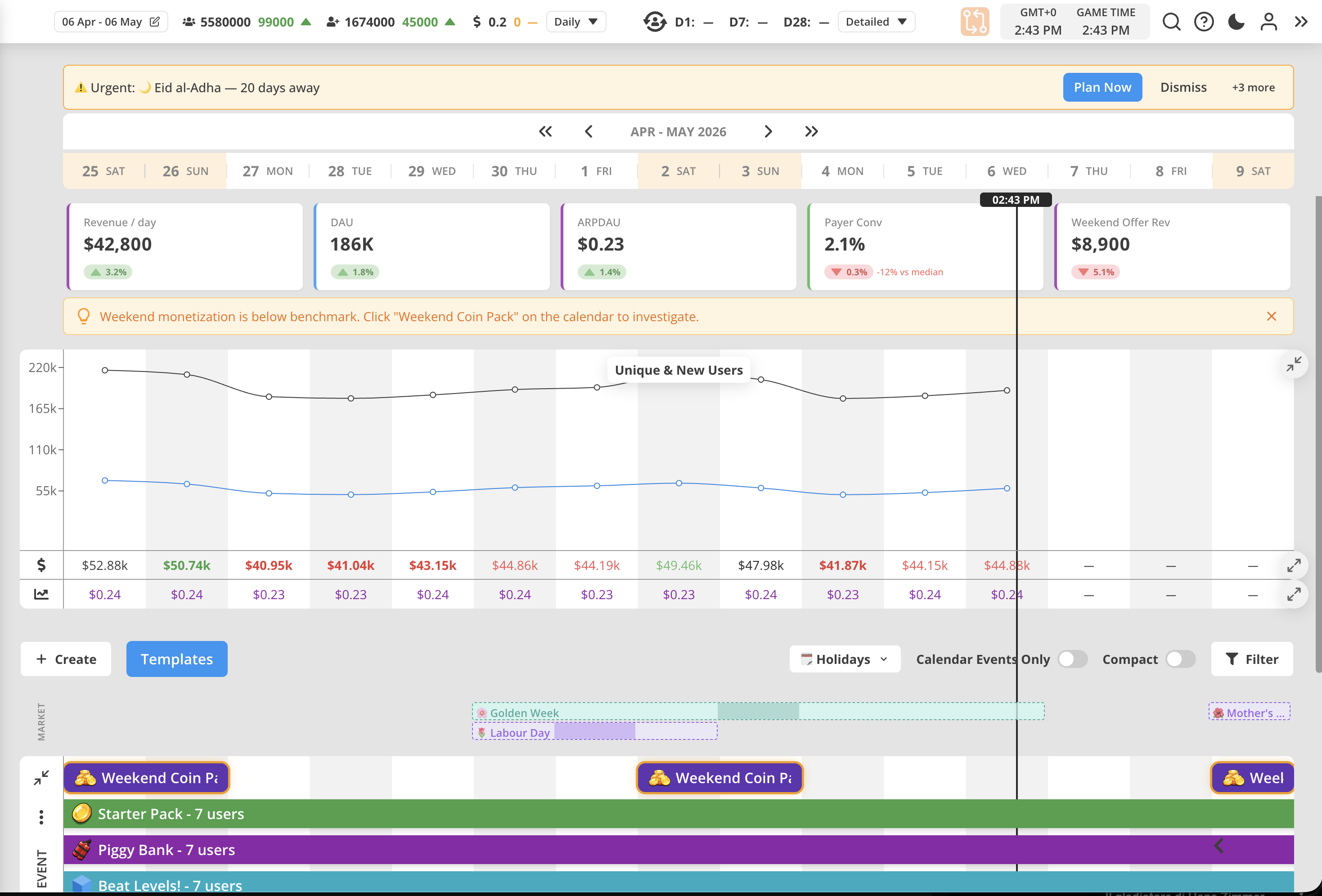
Nia continuously monitors every offer and event in your game. She tracks conversion rates, ARPU contribution, click-through rates, and session timing against your game’s historical distribution. When a metric falls outside expected range, she flags it automatically, no analyst required.
This runs 24/7 across your entire content library. Not just the top 10 offers your team happens to be watching.
Step 2. Diagnosis
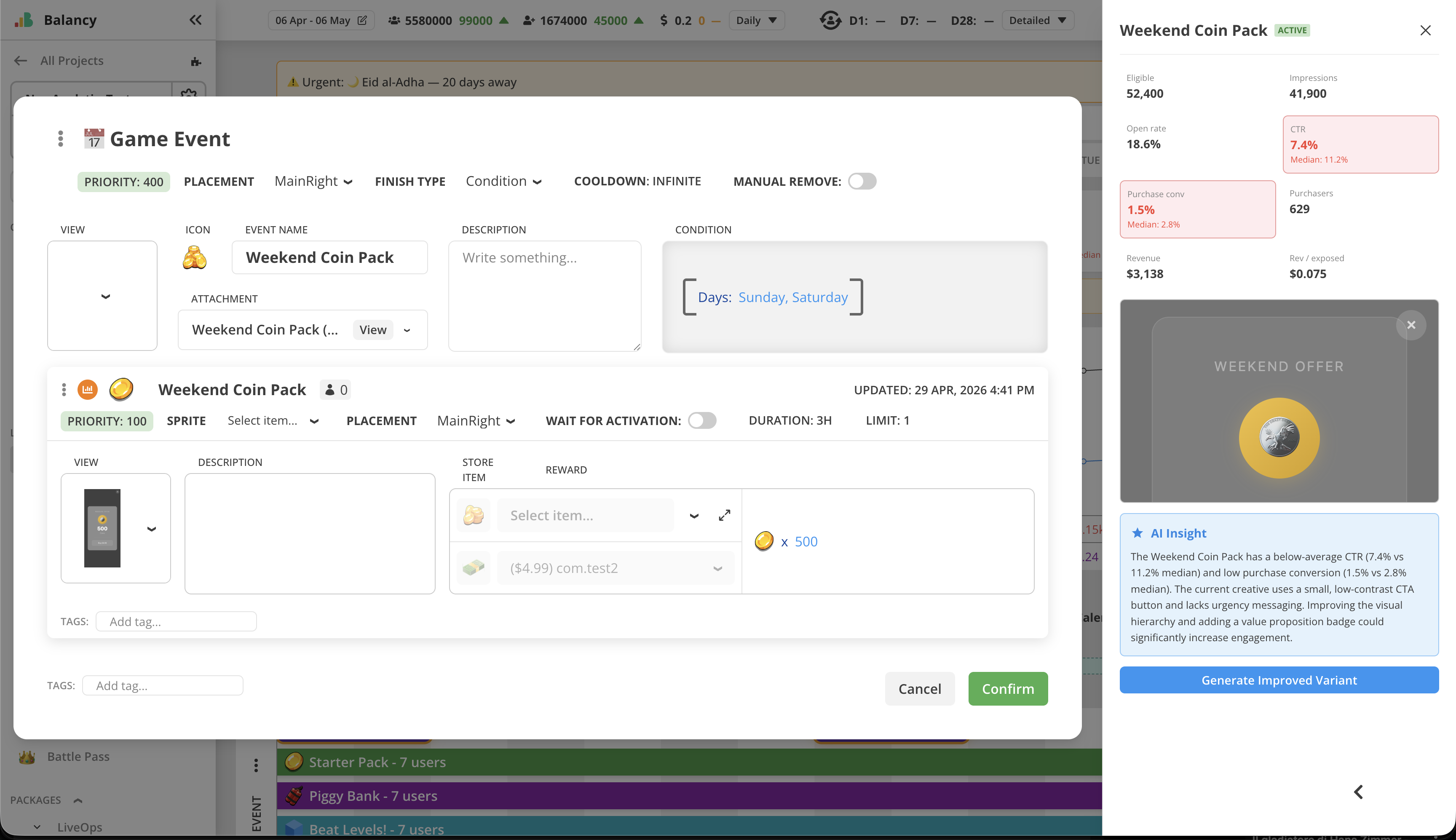
When Nia surfaces a problem, she provides a structured analysis of why the metric is declining.
For a low-converting offer, her analysis might be:
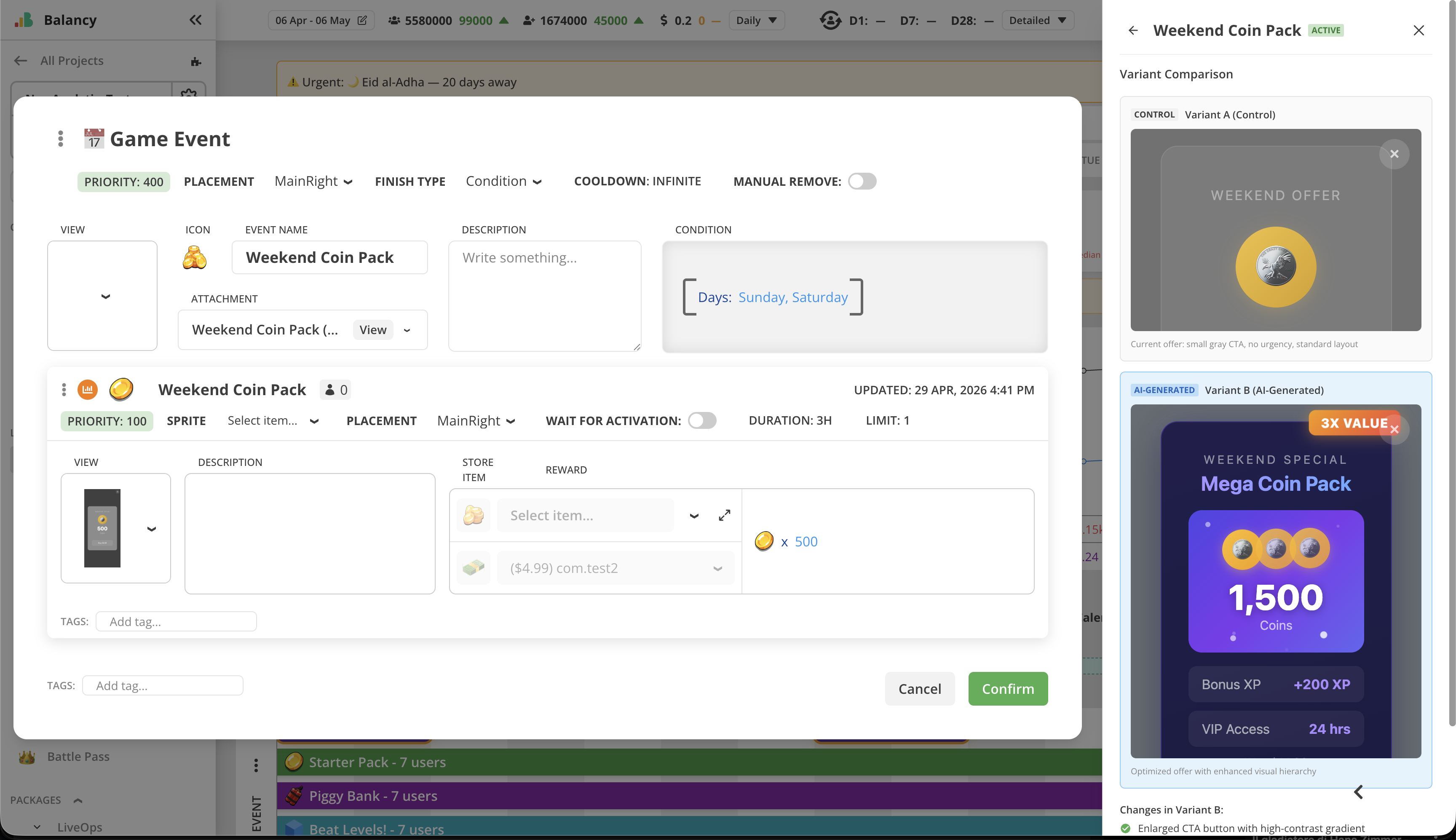
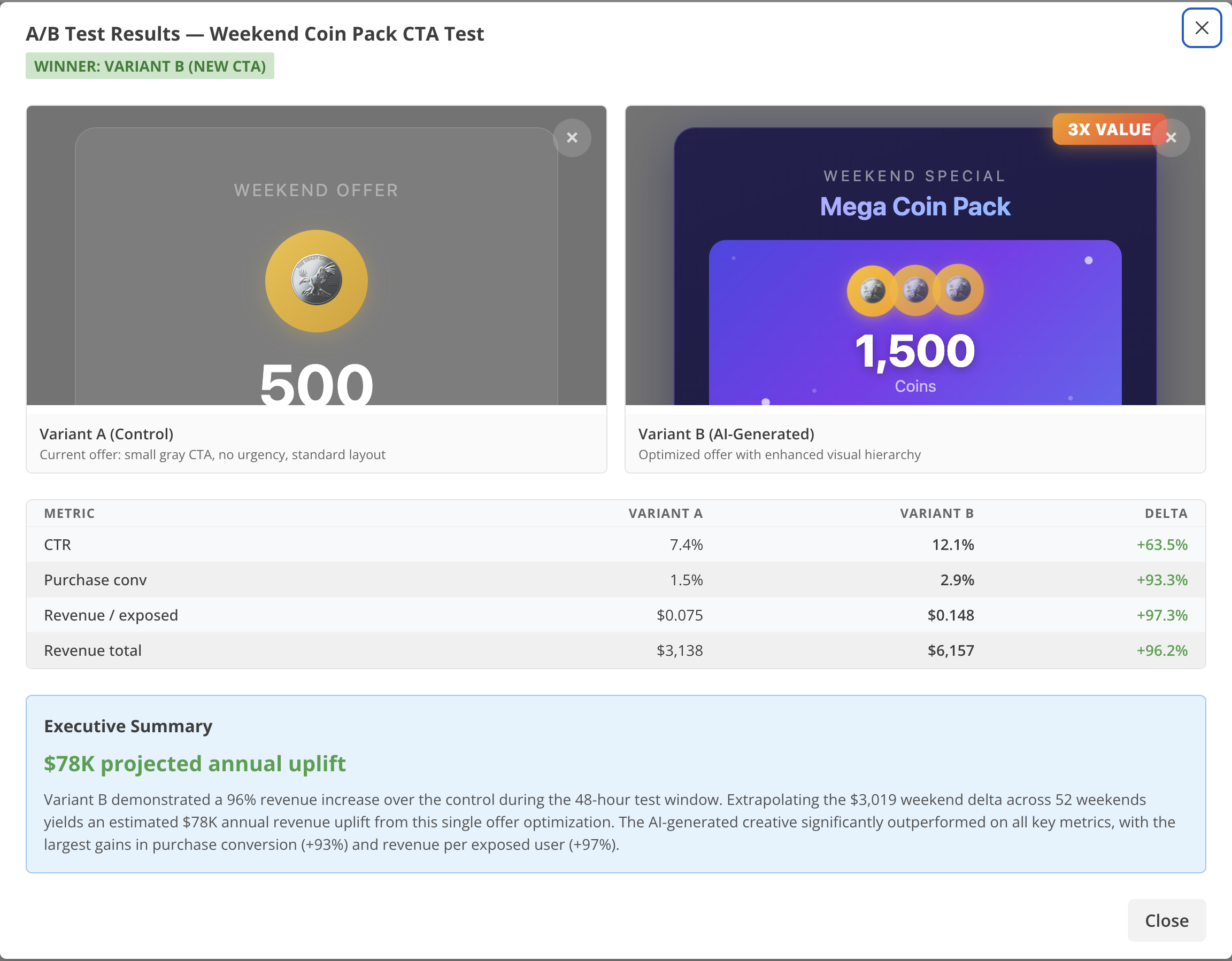
“The Weekend Coin Pack has a below-average CTR (7.4% vs 11.2% median) and low purchase conversion (1.5% vs 2.8% median). The current creative uses a small, low-contrast CTA button and lacks urgency messaging. Improving the visual hierarchy and adding a value proposition badge could significantly increase engagement.”
This is grounded in your data, not generic best practices.
Step 3. Generation
Nia generates a concrete improvement. For UI-layer offers, she produces a fully redesigned variant using Balancy’s UI builder – restructured layout, resized CTA, added a badge, rewritten value copy. For pricing or content changes, she proposes adjusted parameters with projected impact.
The generated variant is not a static mockup. It is an editable asset in your asset library from the moment it’s created. Your team can review it, modify it, or approve it as-is.
Step 4. Testing
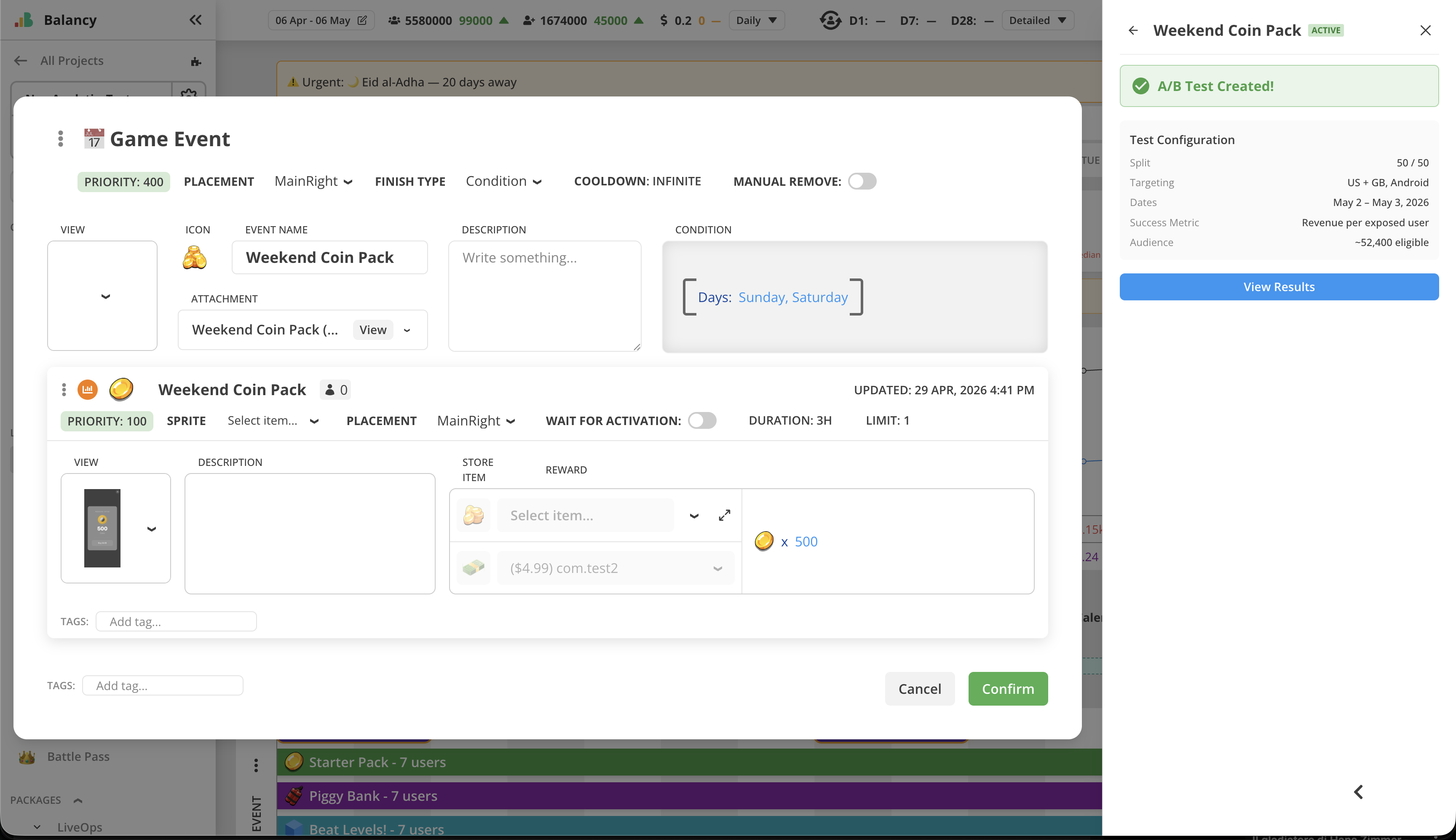
In one click, you can launch an A/B test: current variant versus AI-generated variant, split across your live player base with configurable traffic allocation. The test is live in seconds without releasing a new build.
Stage 5. Measurement and projection
Results accumulate in real time. Once statistical significance is reached, Balancy highlights the outcome with a projected annual revenue impact.
What this means in practice
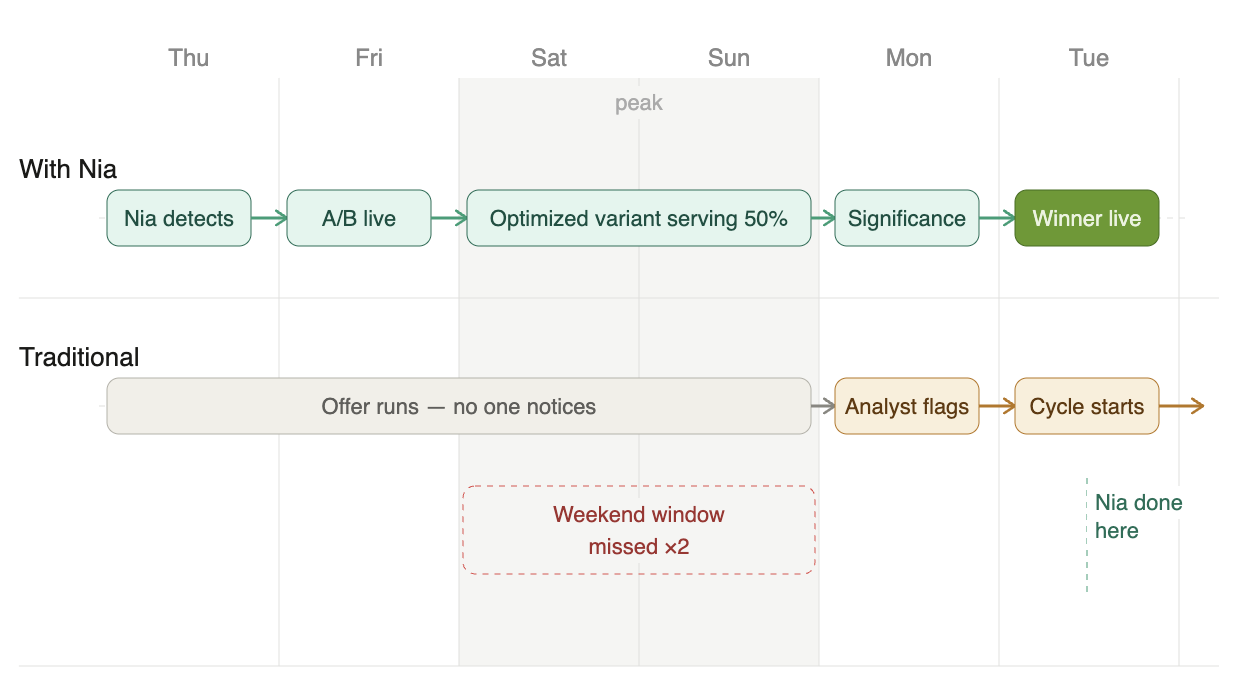
Consider a concrete scenario. It’s Thursday. Your new offer has been running for three days.
Nia detects its conversion rate is 68% below median for offers in this price tier. She generates a redesigned variant in under two seconds. You review it in the side panel, launch the A/B test, and move on.
By Saturday (peak playtime) the optimized variant is already serving 50% of your weekend audience. By Monday you have significance. By Tuesday you’ve shipped the winner permanently, again with zero build.
The same scenario under a traditional workflow would extend into weeks of work. The analyst will flag the problem probably only on Monday next week and the release cycle will start where the Nia-powered team has already finished.
What’s available now, and what’s coming
Available today:
- Real-time LiveOps dashboard – manage events, offers, A/B tests, and custom configs without touching a build.
- Nia AI assistant – ask questions, manage game content, and write extension scripts in natural language. Early clients are already reporting faster Balancy onboarding thanks to Nia.
In development:
- Automated offer performance monitoring with AI-generated insights
- One-click AI variant generation via the UI builder
- Revenue projection for A/B test results
Our vision:
-
Closed-loop autonomous optimization: detection, generation, testing, and rollout of LiveOps configurations with minimal manual input
-
Beyond offers and events: AI-driven tuning of difficulty curves, progression pacing, economy balance, and content scheduling
-
Real-time personalization: pricing, content, and UI dynamically adapted per player cohort
-
LiveOps teams shift from execution to strategy: defining goals and constraints while AI handles scale
Have questions about Nia? Reach out to our team – we’d love to hear from you!