A few months ago, we hosted our 10th Balancy webinar — and for the first time, ran a live LiveOps deconstruction with the studio behind the game.
We asked Michael Khripin, Product Owner at Balancy, to break down Mad Skills Motocross 3 as a new player: onboarding, retention hooks, monetization logic, and LiveOps pacing — exactly as they unfold in the player journey.
Joining him was John Wright, CEO of Turborilla, who responded in real time, explaining the intent behind the systems and where the team is still evolving them.
Below is a condensed deconstruction of what actually drives longevity in one of the most enduring racing titles on mobile.
Turborilla in AppMagic
According to AppMagic data, Turborilla’s flagship titles continue to monetize efficiently relative to their download volumes — especially notable for a game that’s been live for several years.
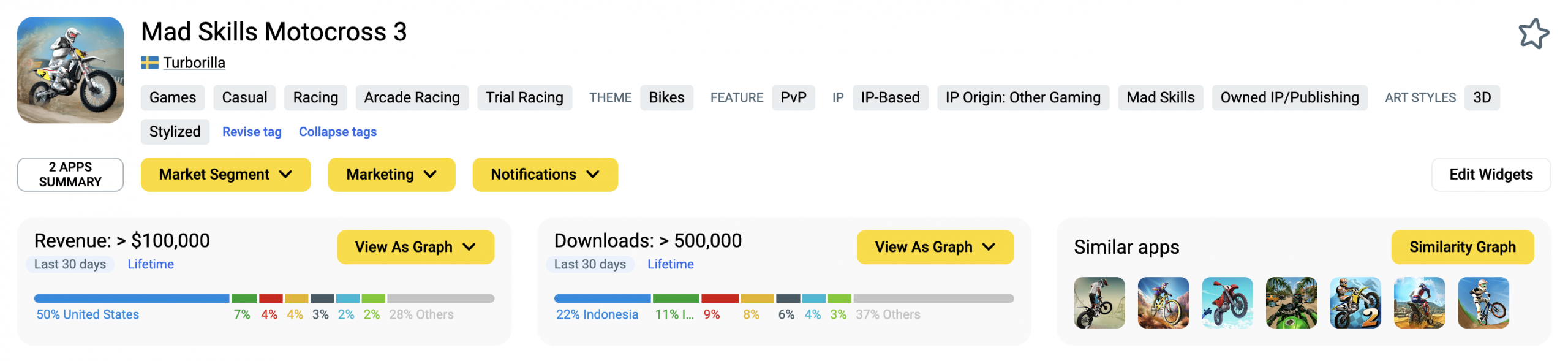
Note: AppMagic does not include ad revenue, which is meaningful here given the hybrid model.
John shared a striking benchmark during the session:
“We increased Android LTV by 25% for a four-year-old game.”
That sets the tone for this deconstruction:
the real gains here didn’t come from adding more content, but from tightening the systems underneath.
Built for Retention, Not the Content Treadmill
When asked what Turborilla prioritizes in 2025, John highlighted two pillars:
-
Meta progression — the only thing that reliably carries players past Day 7–14
-
LiveOps systems — designed to scale without exhausting the team
“You don’t want to worry every sprint about having enough new content. You need systems.”
Michael’s task was to identify how those systems appear in practice.
1. Onboarding That Funnels Players Toward Community
Early in the game, Mad Skills Motocross 3 introduces multiple systems — but gates the most “sticky” one, Leagues, behind progression.
Notably, players see League promotions before they can access them.
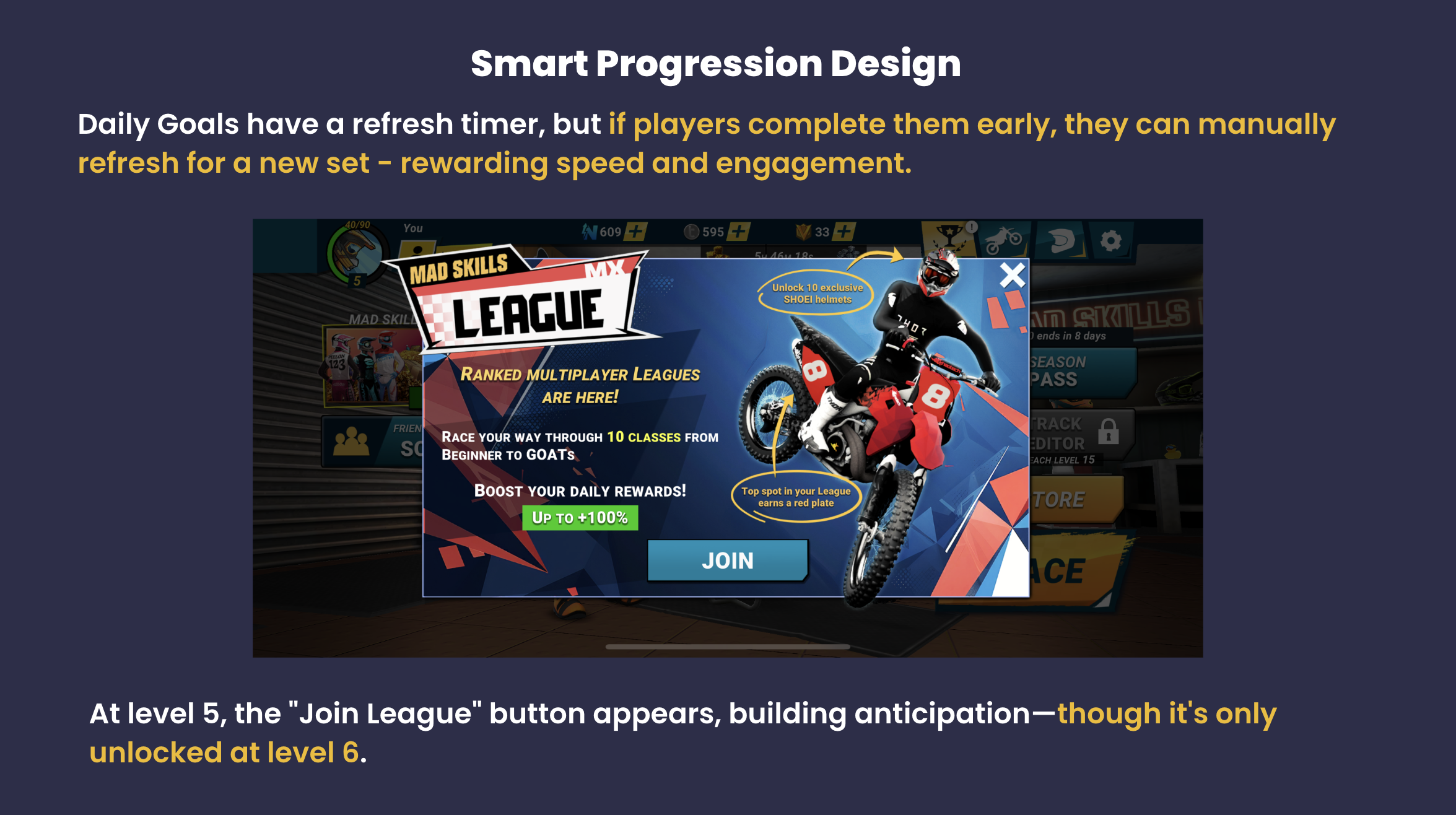
This is deliberate.
Turborilla observed a churn point where career mode begins to feel repetitive. Teasing Leagues slightly early creates anticipation and FOMO, nudging players to complete “just one more run” to unlock a far more competitive, social mode.
“It was classic FOMO — and funneling.”
— John Wright
2. Daily Goals That Extend Sessions (Without New Content)
Daily goals don’t stop when you complete them. If time remains, players receive another set.
This does two things:
-
Extends session length through achievement loops
-
Encourages replay without requiring new mechanics or events
John’s philosophy here is unapologetic:
“Today’s session matters more than worrying about tomorrow.”
3. A Shop Designed for Casual Spenders
The shop surfaces low-price items first, rather than anchoring with expensive bundles.
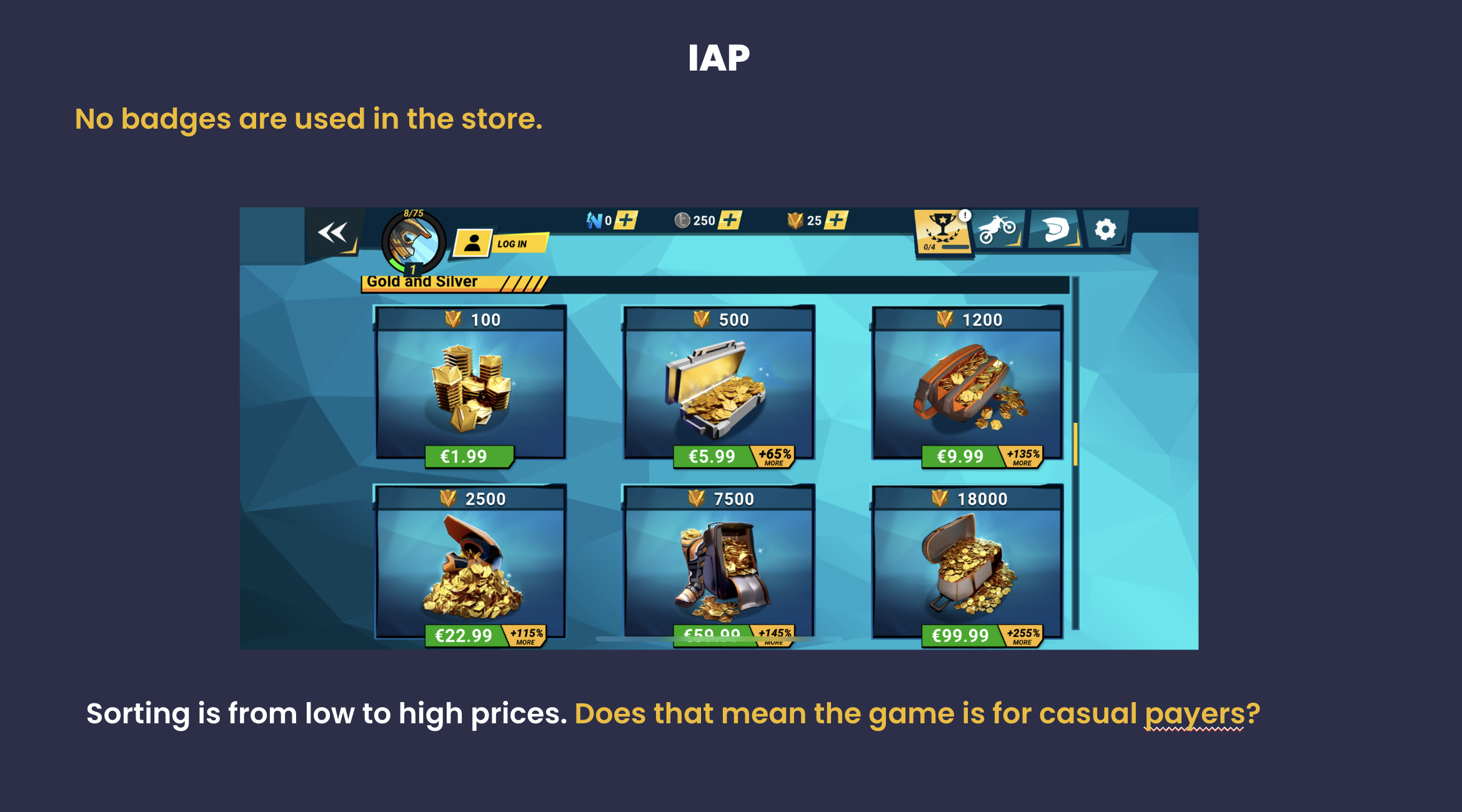
This aligns with Turborilla’s audience:
-
Low CPI
-
High volume of small purchases
-
Hybrid monetization (~40% IAP / ~60% ads, as discussed live)
Michael also noted the absence of heavy “Best value” badges. John acknowledged this as a potential future test — a reminder that even mature systems keep evolving.
4. Subscriptions: Value Signposting, Real Price Sensitivity
The game offers three subscription tiers, visually highlighting the most premium option.
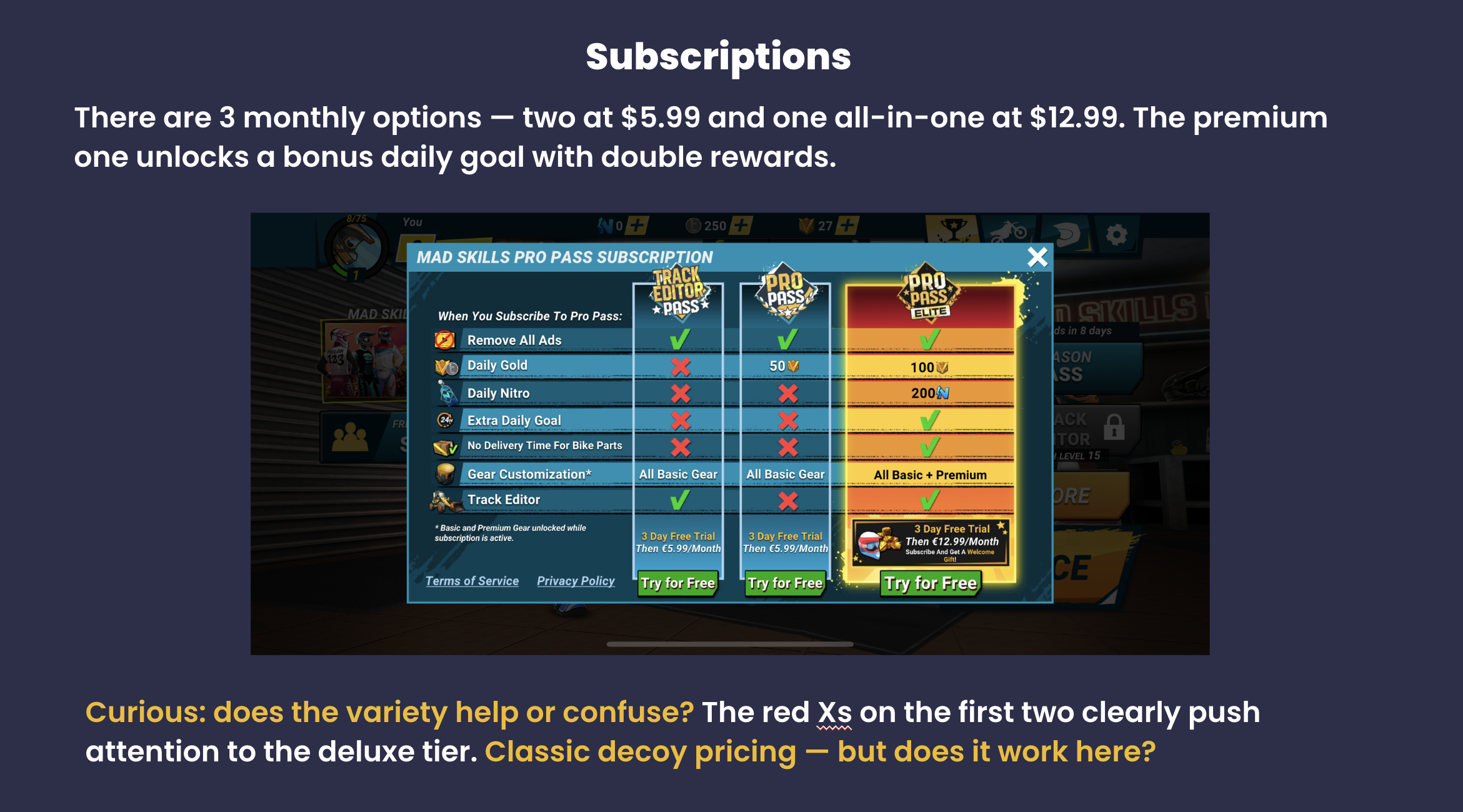
While this follows classic “decoy pricing,” John clarified that:
-
Most users still choose cheaper tiers
-
The real upside comes from upgrades over time
-
Commitment grows with engagement, not just presentation
5. Early Power Offers — and the Skill Risk
A core first-purchase driver is an early special offer for a stronger bike, shown across multiple surfaces.
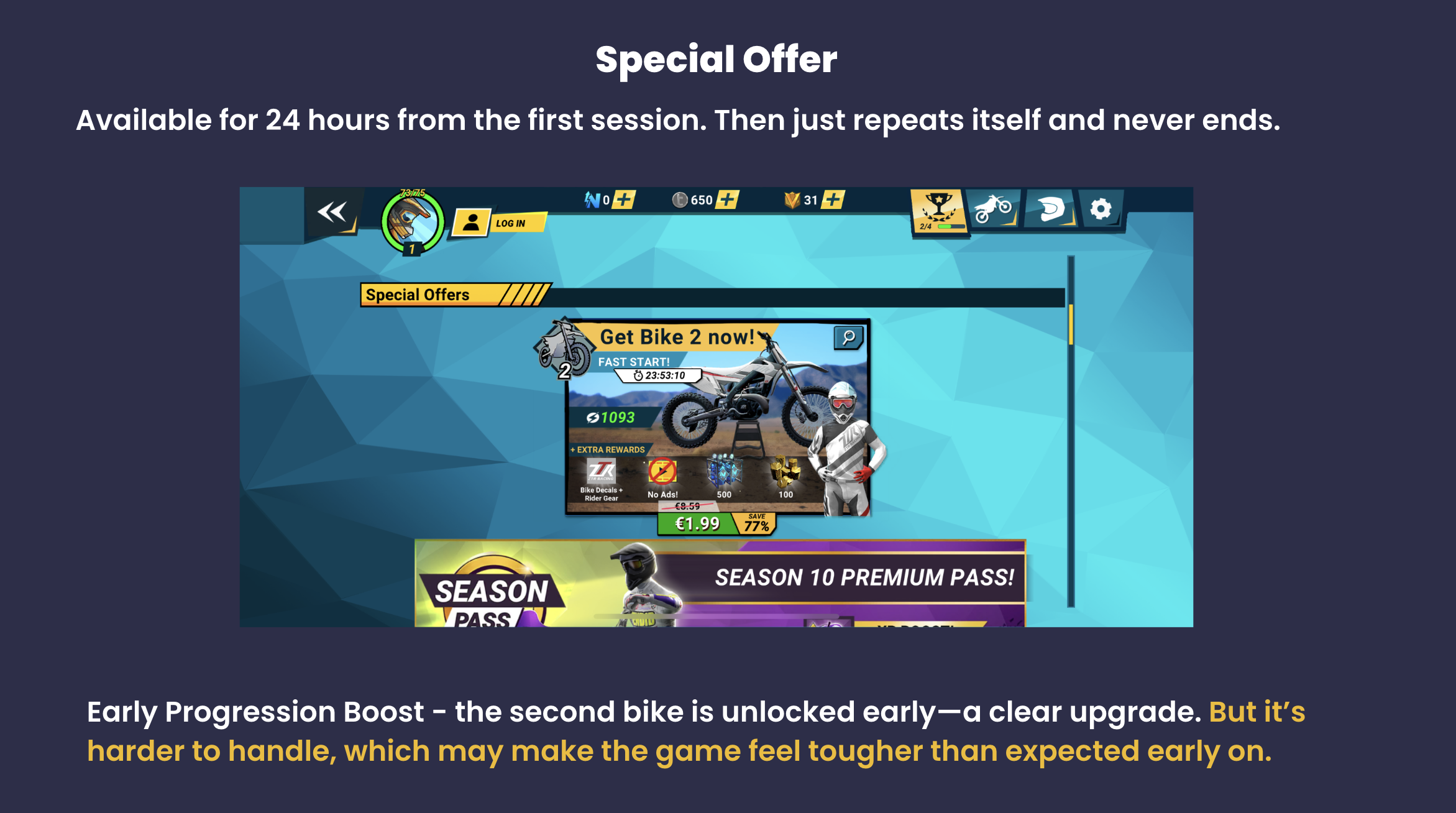
The intent is clear:
-
Push players into the next “world,” a major retention milestone
-
Increase commitment through early spend
But Michael flagged a genre-specific risk:
this is a physics-based, skill-driven game.
Selling power too early can worsen the experience if players haven’t mastered control yet.
LiveOps takeaway: Starter packs should accelerate progress — not introduce friction.
6. Cosmetics as Identity, Not Power
Daily deals and cosmetic offers play a major role.
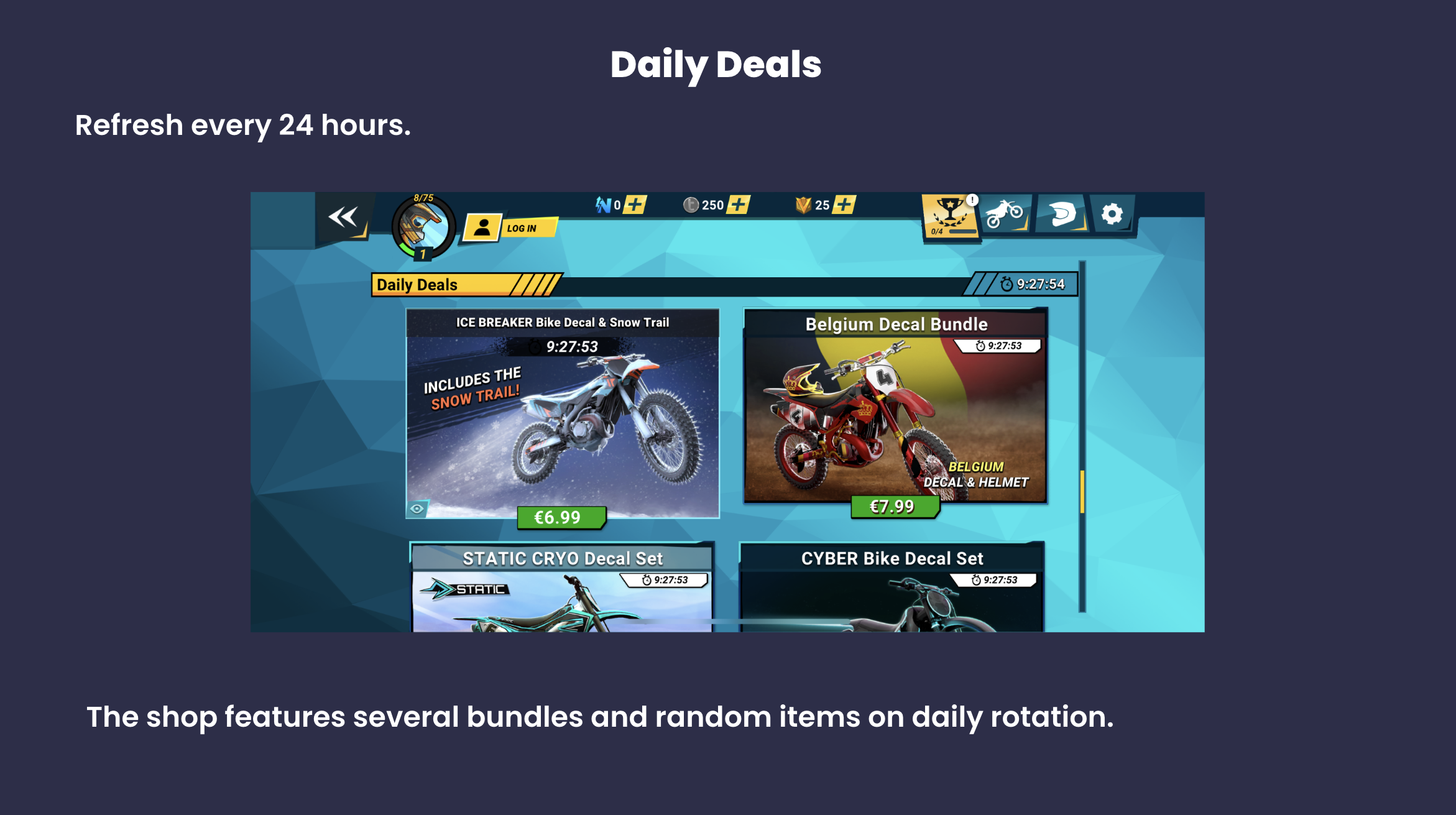
Cosmetics here:
-
Represent a significant share of IAP
-
Are amplified by real-world brand integrations (Fly, Fox, etc.)
-
Build credibility and identity within a motorsport audience
Pricing is guided by long-term portfolio data and testing — not raw functional value.
7. Ads: Variation Beats Uniformity
Michael noticed multiple visual styles for “Watch Ad” CTAs — even on the same screen.
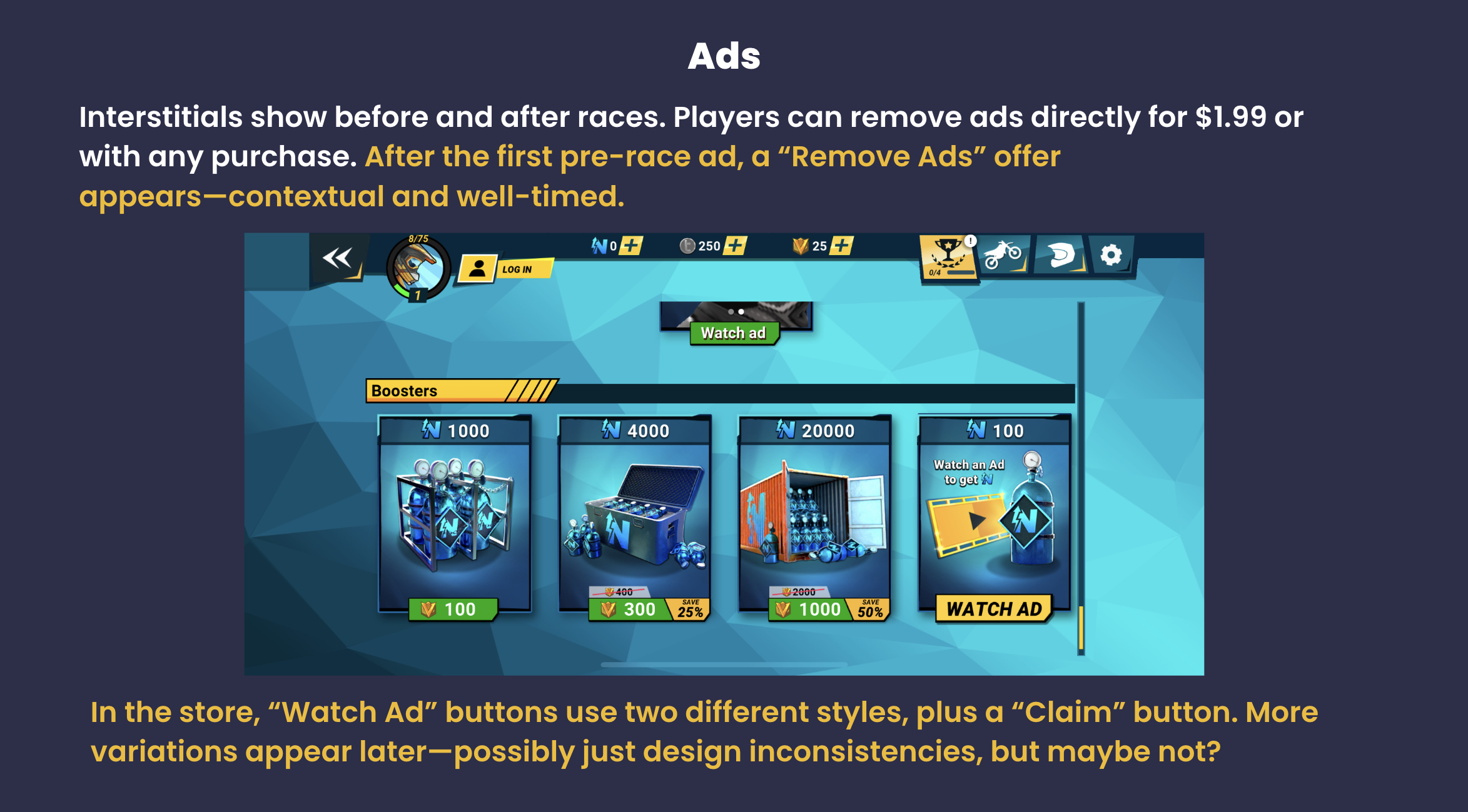
John explained that uniform ad buttons lead to blindness. Visual variation improved engagement historically.
The game also offers Remove Ads almost immediately after the first interstitial.
In Tier-1 markets, this converts well — players simply prefer uninterrupted play.
8. “Renting” Cosmetics to Build the Habit
Players can unlock basic cosmetics by watching ads.
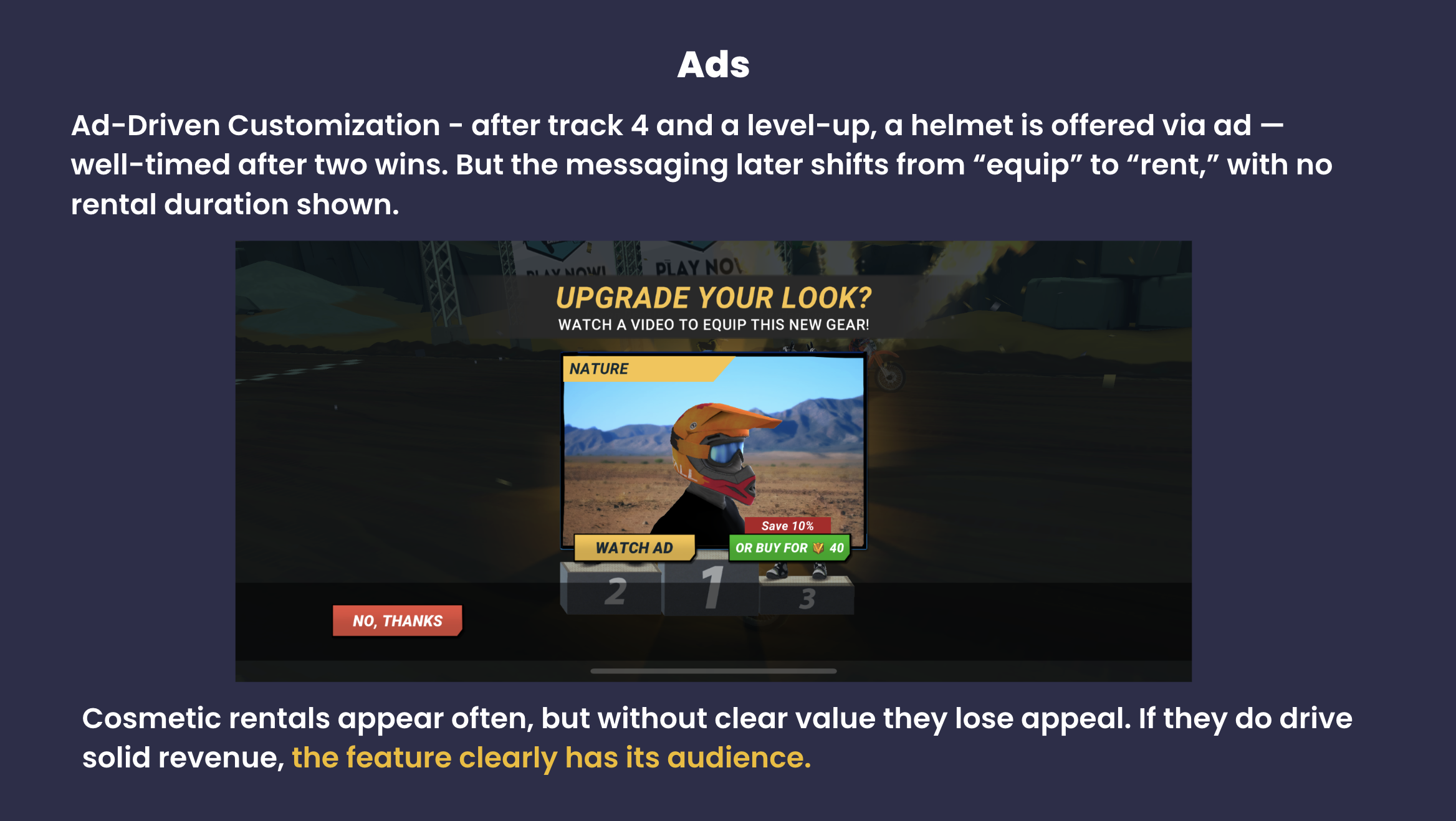
The goal isn’t the items themselves.
It’s behavior training:
-
Teach players to customize
-
Normalize identity expression
-
Build taste before monetization
9. Segmentation Today, Personalization Tomorrow
Some offers are still generic (e.g. resources offered despite surplus).
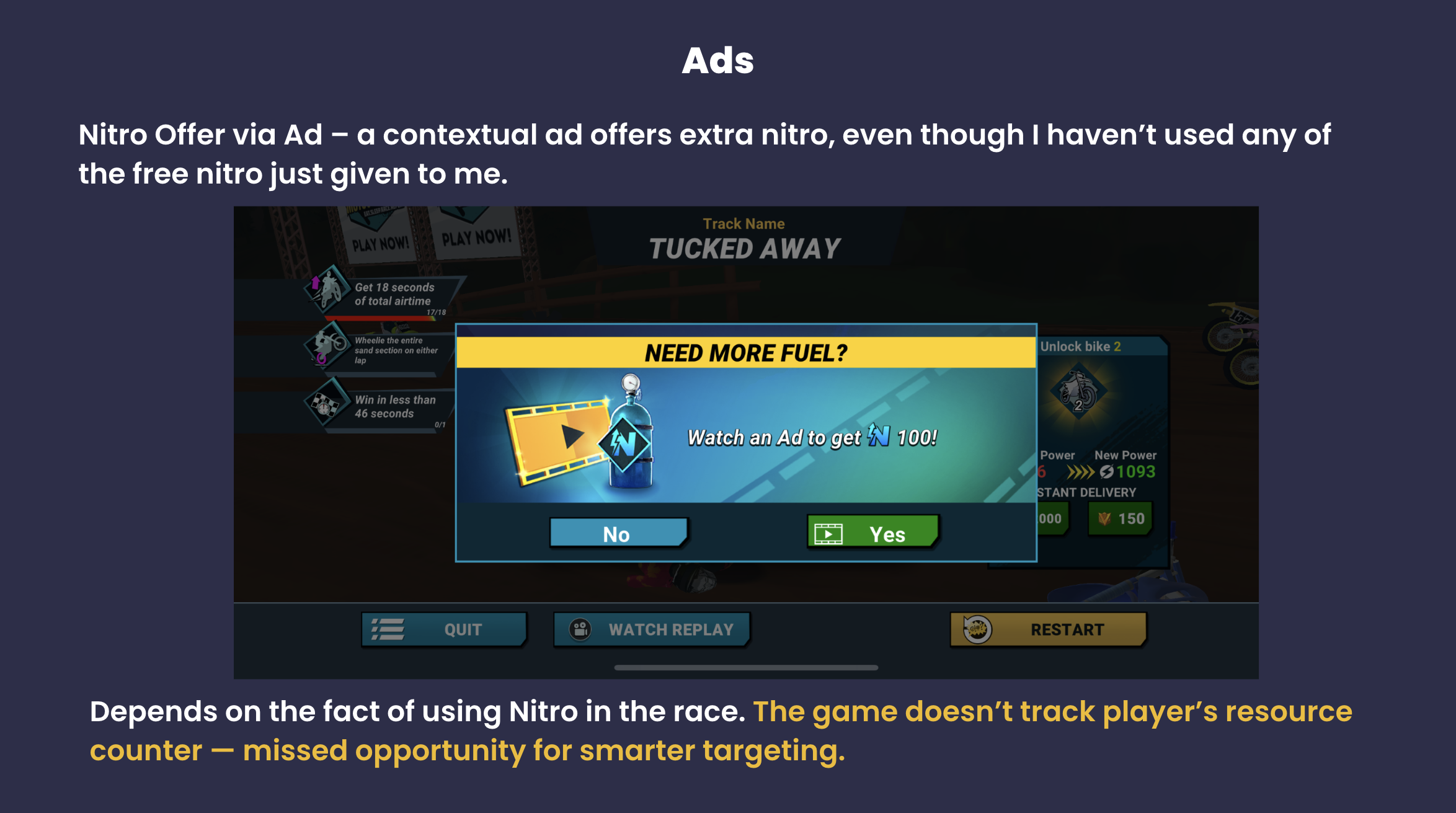
John confirmed Turborilla currently relies on segmentation, with deeper personalization on the roadmap — a logical next leverage point given system maturity.
10. Reactivating Old Season Passes (A Standout System)
Players can reactivate past season passes and play them as if they’re live.
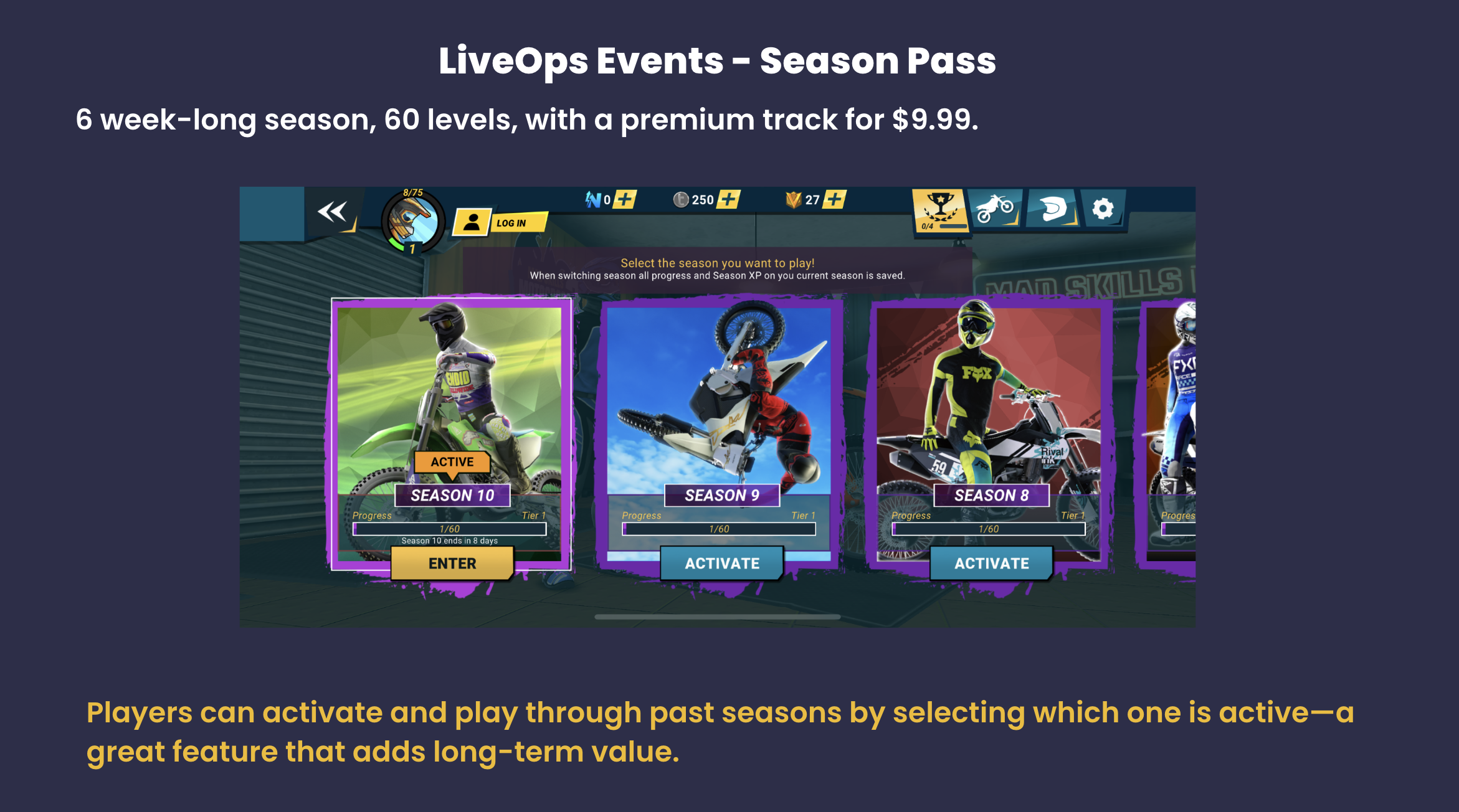
This:
-
Monetizes previously “dead” content
-
Increases retention rather than hurting it
-
Builds trust with late-arriving players
“Otherwise, that content just sits there forever.”
— John Wright
For Michael, this was one of the strongest systems in the deconstruct.
11. Buying Season Levels as a Safety Valve
Players can pay to skip levels in a season pass.
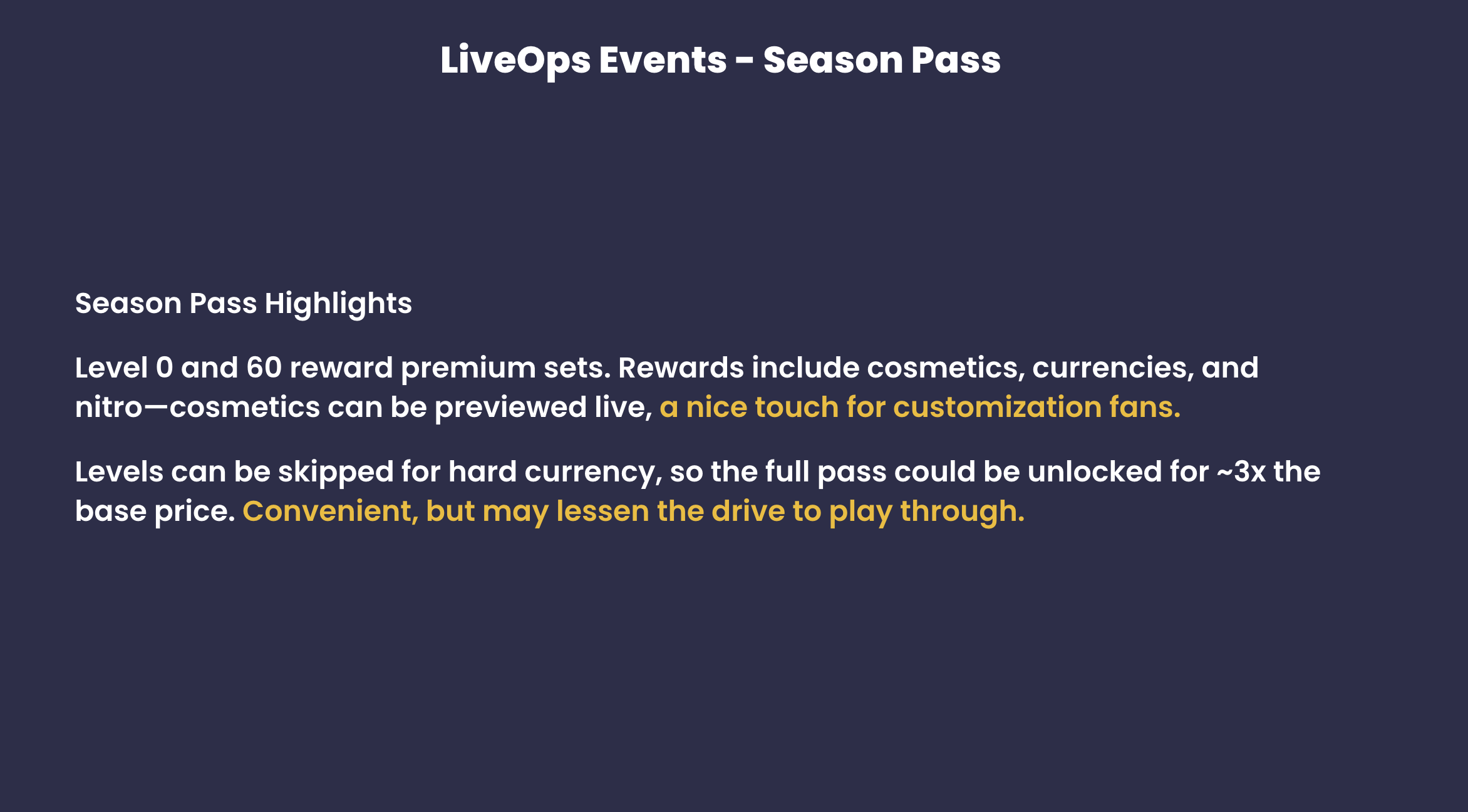
This isn’t the dominant behavior — it’s a churn prevention tool, allowing players to finish passes even if difficulty spikes or time runs short.
12. Competitive Events Embedded into Core Play
Short leaderboard events appear directly inside career mode.
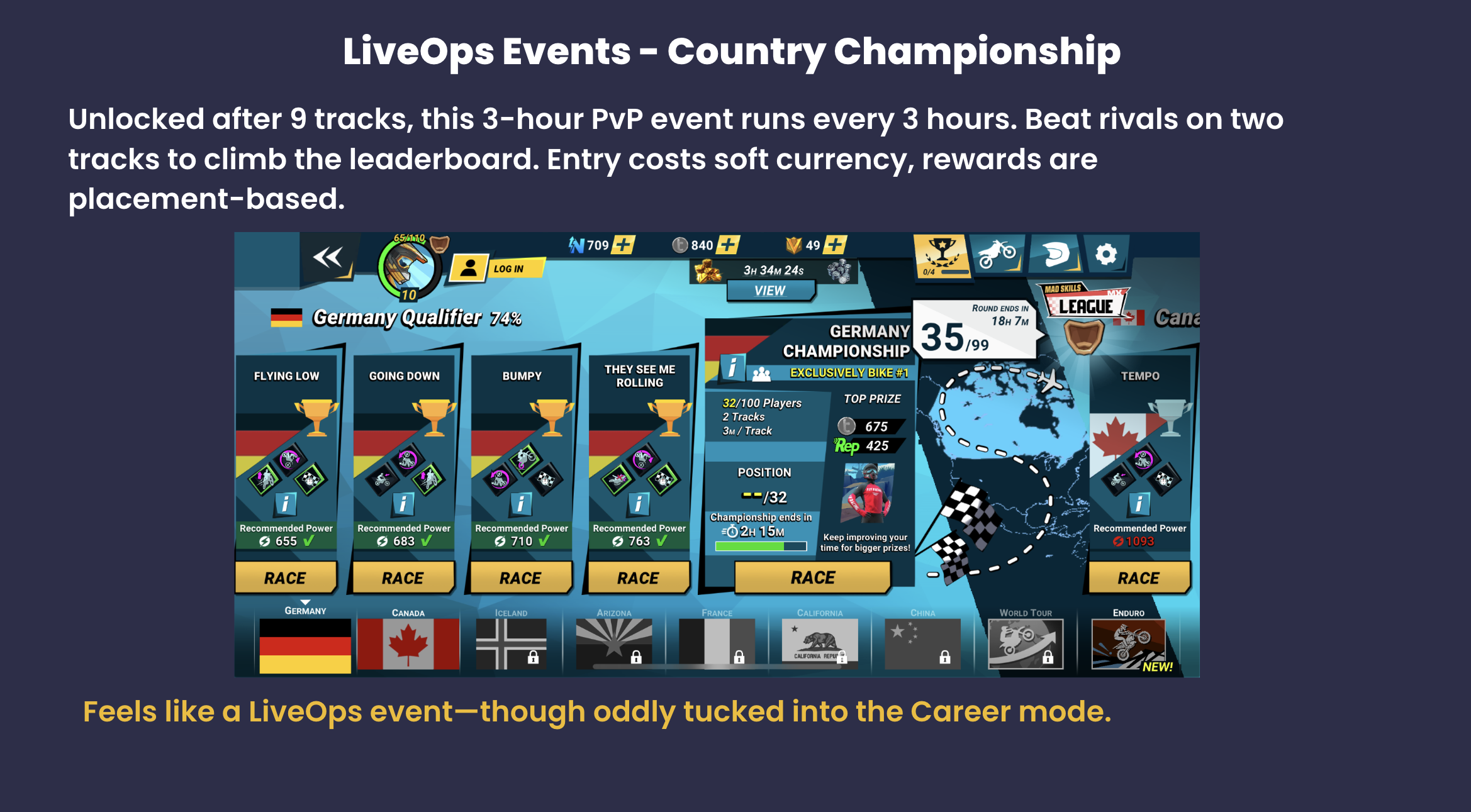
This acts as a soft introduction to Leagues, reinforcing competition as a core motivator long before full PvP unlocks.
Final Takeaway
Mad Skills Motocross 3 demonstrates a mature LiveOps approach:
-
Systems over content velocity
-
Identity over raw power
-
Community over novelty
-
Reuse over reinvention
The biggest lesson isn’t any single feature — it’s how intentionally these systems work together to support a game well past its launch window.
If you want longevity, optimize the rails — not just the ride.
Want the full deconstruction?
This article covers several key LiveOps systems in Mad Skills Motocross 3, but the complete walkthrough goes deeper — including additional events, tuning details, and live discussion with the team.
🎙️ Watch the full webinar:
Mad Skills Motocross 3 Deconstructed — Inside Turborilla’s LiveOps Design